Friday, August 10, 2012

@-dance w/EXO \\ Tabor Robak & Gatekeeper


EXO just came out. Download-- it's FREE. A 35 minute game by Tabor Robak, set to the album of the same name by Gatekeeper. It's part of a dispersed visual project-- the album artwork, the game, and a font.


Robak says (quoting from this feature):

“Everybody’s making music videos, so it’s time to figure out what the next thing is [...] I think novelty in general is a universally good force that should always be pursued. Newness [...] There’s a real saturation of [audiovisual] work. This idea was a way to set ourselves outside of that a little, with a new thing that didn’t already have a set of established ways to judge it.” 

EXO continues the evolving tradition of designed musical playspaces. Recent excursions by popular electronic musicians into the form-- Brian Eno's Bloom, Bjork's Biophilia, Oval's ovaldna player, etc. Also, the broader tradition of flexible music in general, like improv software by Anthony Braxton, George Lewis and David Behrman, game pieces by Zorn, Cage of course.. notations (Beck's forthcoming "future of the album", sheet music)

It also continues, maybe unknowingly but still more directly and self-consciously, a notgames DIY-realism trend exemplified by thechineseroom's Dear Esther and Tale of Tales' many games, with their preference for detail in content over that which emerges from mechanical variety or process-intensity. And the broader tradition of Hollywood and the AAA games industry, who we inherited these values from (teal & orange).

Not surprisingly, some things in Exo are unique and exciting, others not so much.


It's visually enchanting. Vibrant palettes coloring a wide variety of future-primitive environments from digi-space scenes to deserts to oceans to floating islands and Bioshock-esque jungle-hallways with screens.. lots of melting and spraying and pulsing. The album's PR blurb describes the game's attitude well-- "Pineal activation. IMAX phantasy. Drippy acid ecosystems. HD... everything." Cheeky psych-corporatism via techno-capitalist realism -- Hi-fi is the new underground.

“It’s definitely a response to the popularity of lo-fi five years ago and also the proliferation of affordable high-definition technology,” says Robak. “Everybody’s got high-definition TV. The basic MacBook now is a pretty good computer [...] What HD means to me [laughs] is a commitment to quality and a level of detail.”

To produce some of this detail, Gatekeeper have revealed that they used Hollywood sound effect libraries for the album, those meticulously designed sounds that fill the whole frequency spectrum so elegantly-- these sounds that used to be the exlusive property of money, and now they're READY-MADE. Robak, likewise, says he uses texture/object packs to skin his virtual environments (Rhizome profile). In the culture of games, we're made to believe that a visual spectacle of this sort requires heroic bunches of money and man-hours. Exo asks-- why not just sample and process, reuse?
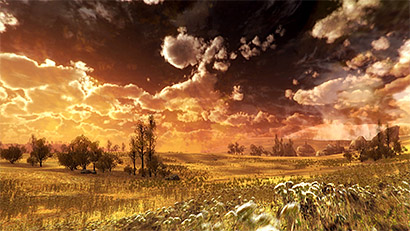


So, it looks-- and in play:

Robak has directed music videos in the past, and the rhythm of movies seems to have had an awkward but not totally negative impact on Exo's qualities as a playform. It's an "exploration" game, but one in which we're automatically "cut" from space to space every minute or so, like in a strange dream or travel documentary, no sense of connectedness between the environments. 

As a viewer, we're kept engaged for the most part. As a player-- no longer any sense of agency in the spaces aside from the forever-moment of motion itself, moving and looking. This is the most recent of what Baiyon calls a "just walking game". And once we accept the value-space of these minimal mechanics, we move on and into them.

At this point the game becomes like a dance. Once we get used to the strange rhythm, the arbitrary force of transportation becomes like a partner for us and we're freed to experience time as time, space-as-time now limited from the top-down. That is to say, the sense of discovery in an environment is a kind of temporal installation of event-signposts and a way in which we recognize space's temporal dimensions. In EXO we more or less hand over control of discovery to Robak.

There is strangely a greater sense freedom here compared to, say, Dear Esther, which is set in a large connected space, but which also limits spatial movement with the comparatively manipulative device of the path (explicit and implicit, we're told what to do rather than just being given variable control in a constrained space). Gone is the possibility of discovery-in-space, and so, again-- discovery happens in time. This is like the experience of playing music: every key press and movement of the camera must feel meaningful, the motion itself, or we'll quit.


Now, the play grew tiring for me about 15 minutes in. The music is exciting, but its intensity is overbearing when sustained for so long in an environment that doesn't listen too closely. The tension between music and play is interesting for a while, but it ultimately falls into a pattern of predictability and unresponsiveness. We're no longer dancing with but at.

This is related to another experience I've had with Gatekeeper. There seems to be a nasty trend in parts of culture, particularly in fashionable clubs-- dancing AT the spectacle on the stage, everyone facing the same direction, and not moving too much, lest they knock into someone or look improper. This is what it was like when I saw them live a few months ago. It's a disappointing way to listen to dance music, which asks our bodies to become one with the space, sounds, and with each other. We're confronted with images and we've been conditioned by them to look forward and submit-- even when we're in music, which is all around us. 

In Exo, what starts as an interesting tension between the fluid and the fixed, play and cut, becomes tiresome once we've gotten used to its repetitions. If the rhythm of the cuts was more variable, maybe this would have felt different, or maybe even if the static music track itself changed more.. admittedly, there's a redemptive climax at the end during the final track, a quick splashy recapitulation of all the spatial motifs, transformed, melting now. But...


Variation, change, dissolve-- these things are missing in the structure of the playspace for the most part. Structural elements: transition-forms, speeds, object properties: our own variables, assets, must be given over to the same process of flow and re-use to which Robak and Gatekeeper have subjected the ready-made assets of the cultural commons in their sampling. A psychedelic realism, of process and change, hinted at in some of the moods here, must replace the object-obsession of capitalist realism/psych-corporatism that we're given instead.

One direction >> For a just-walking game: WALKING SPEED is the fundamental variable source of emergent rhythm, along with look-speed. It determines how quickly objects move on the screen-- as they grow from small to large and move past us, a visual pulse is established. Walking speeds change in EXO, and occasionally they feel right, but they tend to be too slow, working neither with nor against the rhythm of the music, but again-- at it. //


And finally, Exo as music game:

The soundtrack's implementation is static, suffering from the same alienated attitude to the relationship between music and play that we've come to expect in so many of these pop-game projects, like Pitchfork/Killscreen's recent INTEL Soundplay stuff, that assume a fixed soundtrack is enough. The guiding question here: games function like music videos? As a simple answer to this question, Exo works. It's the dance idea-- we can dance even to music that doesn't bend to our wills, right? True to a certain degree, and in many ways I enjoyed the direction of freedom in the game more than I did the live performance (and both as dances).. but something is lacking...

In successful engaged-performance, musicians have always responded to the energy of the dancers-- there is a feedback relationship here, as there is between musicians playing with one another. Feedback is a structural necessity in meaningful music-making. In fixed media, like a music video, the feedback relationships have been frozen, contained to static values in the forms themselves, and they leave us no affordances to further engage them (though they're playback mechanisms do so). The production of such forms involves feedback between audio and visual information, moderated by our own desires, and this is something we've become pretty good at.

In open forms, where dynamic variables are in play, to neglect to allow the sounds to take part in that variability (which we've already become pretty good at doing with visuals) is a mistake, and a common one. As a tension, it can be powerful, but there must be a release-- an expansion to counter the contraction-- if there's going to be any movement toward the space of harmonies of change

Automated musical change is possible here, and it will be useful. Sounds tied to spaces and events and processes, allowing us to engage in play once again with our music. The process isn't too difficult, in fact just a continuation of that bricolage and coding work that's already been started, now using variables to control musical parameters in real-time. It wouldn't be difficult to cut the album tracks into loops and event sounds, 303s and beats and hollywood sound effects, game events triggering playback, volumes changing, maybe pitches, too.  Already-- a whole new world of possibilities, and we're only beginning. The spaces themselves will need to be musical of course, and the music spatial, liquefying those distinctions-- but this isn't an impossible challenge by any means, and both the spaces and music of Robak/Gatekeeper are already inclined in these directions.

This edit of Exo (sounds only) is an example of how samples from the album could be repurposed for use in a highly dynamic playspace. It was made with only three processes: cutting samples (changing start and end times), pitch-shifting them, and rearranging them in a layered, multi-channel space.


We can imagine that each chunk of audio in the picture (which is the pre-mixdown arrangement layout of the soundcloud track above) is triggered by a game event, either in play or automated, and that this particular sequence was only one of many possible realizations. Deciding how the start positions and pitch-shiftings could be determined by game events would be an interesting space to work in. And this is without manipulating volume, even, or having access to component objects, like solo 303s or sfx or hihats. There are a lot of possibilitites. This example is a very simple design of what things could be like.

>>>>>


Hi-fi is the new lo-fi, and this is a gift to the commons-- the continuing project of opening ourselves to everything as a material... a gift-- so long as it doesn't stay put. Fashions come and go-- this sound as a "now" thing will be gone soon, but the trajectory along which it's a point will stay in motion.

The sooner we get to the point of seeing/hearing things for what they are rather than what they're trying to be-- the better. All sounds as the space we're playing in. All images and structures, too.

Exo brings us face to face with tensions that have the potential to lead us in this direction. Keep moving. When we can play Dear Esther and see that it's greatest charms are in its imperfections, an uncanny-realism with proudly-virtual spinning sprites-- then we've begun to arrive at the right place, an awareness of the actuality of form. 

When HD has become easy, ready-made, how does professionalization defend itself against the amateurs, bricoleurs? It can't-- ultimately, this is the project of the dissolve of the object and static values, becoming an infinite space of pure possibility and motion for us all. Again-- as long as we stay in motion.


Saturday, June 16, 2012

Played Meaning (Concerning the Spiritual in Games)


0

There has been talk recently about the word "game" and what it ought to mean. Some would like it to mean something very rigid, like Salen & Zimmerman's definition: "a game is a system in which players engage in an artificial conflict, defined by rules, that results in a quantifiable outcome." They see a value in this tradition. Others would like the meaning to be more fluid. By comparing the above with even just one more definition, Roger Callois', "an activity which is essentially: Free (voluntary), separate, uncertain, unproductive, governed by rules, make-believe", we can get a sense for the amount of necessary "tradition" that's actually at stake here-- almost none. These meanings are fluid, generative, subjective.

Now: a game is something that we play. A videogame is a digital playspace.

Why can't we use another word to describe playspaces in general, and thus preserve game's goal-oriented meaning? Because we are content with using the word "videogame" to define this form, at least for now. And videogames aren't even games in the "formal" sense of the word. They tend to be composite forms. Of what? Activities, toys, instruments, sandboxes, etc... ("games", too). Our intuitive understanding of what a videogame is and can be has eliminated the usefulness of game's sanctified definition in our present circumstances (whether or not they qualify as "games" in the formal sense, SimCity, Electroplankton, etc. certainly qualify as videogames). "Game" is also now used as a convenient shorthand for videogame or computer game, and other playspaces that resemble those. What we used to enjoy calling a game (i.e. Salen & Zimmerman's formal definition): Shawn McGrath's new term for this is "fucking game." "Math game," or "competition," or "school" are other possible alternatives.

A game is something that we play. A videogame is a digital playspace. This is the shape of games to come. To impose stricter definitions will only serve to stifle creativity and unnecessarily celebrate past trends in favor of present and future possibilities-- this is already happening.

If these proposed definitions are so broad as to include everything, and now everything is thus a game, then let's play everything! 

1

There's been talk about games and what they mean and ought to mean.

It's not possible to make a meaningful game. Likewise, it's not possible to make a meaningful song or picture or story. Meaning arises from our interactions with these forms, from how we play them. (It is possible to make a good game-- focus group testing is helpful here. Goodness is not great, though-- it's useful; it works rather than plays; this seems to describe the bulk of most design processes).

Games with a didactic quality like Jon Blow's Braid can fool us into thinking that meaning is a thing that is being created and then handed down to us-- the intensity of the implied value systems that come packaged in game designs are often mistaken for the meaning itself. Sometimes our perceived meanings line-up very neatly with what we're told are a game's intended meanings, and this can feel good, but such an effect is incidental rather than essential in any way.

It's not possible to make a meaningful game, but all played games are meaningful. Meaning can be generated but not located. It's a process rather than an object. 

Certain boundaries in a playspace will encourage certain types of play, and from these, if they're played intuitively and honestly, we experience the intensity of this thing called meaning. We then sometimes attribute this meaning to the creators of the game, and this is wrong. We can thank the creators, but we need to respect our own subjectivity (though to then thank ourselves would be foolish-- can we learn to thank the play impulse that somehow exists both inside and outside of ourselves?)

2

The relationship between music and videogames is not a rhetorical one, it's not just an analogy-- the language describing it may be, but the various identities are a fact. Structurally, there's little the two forms don't have in common. This has design implications-- rhythmically, formally, texturally, etc. Most importantly, in practice, both music and games are played-- and can be played in very similar ways.

Musical instruments are games, as are compositions. They are possibility spaces with boundaries implicitly or explicitly inviting certain types of play.

Videogames are not competitions by necessity, they are play-spaces. Play is the subject and the source of meaning. How do we play? The kinds of meanings that exist in music are the same kinds of meanings that exist, fundamentally, (but lying latent), in games-- they don't point at anything but the experience itself, at the materials and interrelationships that form the binding structures of that process.

This kind of meaning, and how it doesn't point at anything (it just is), is the reason why some people call music abstract. But music isn't abstract. Meanings that point (signs --> signifieds (words, narrative, realism)) are abstractions, divisions/boxings, of reality-- they necessarily leave a remainder. Musical meaning doesn't box anything and thus encompasses everything. Musical meaning is concrete. (The social/contextual meanings in music, what Adorno calls the "historical", point away from this toward a more linguistic system of signs. But this system, too, is fluid. Remember: we've all only ever experienced, and are continuing to experience, one piece of music (our own)).

There's a relationship between musical meaning and mathematical meaning-- at it's most basic, harmony (pitched and non-pitched) and its foundation in simple arithmetic. These identities become more vivid (in our minds, at least, if not our ears) when we study scores and consider those sets of instructions as the music itself-- this is how schools like to teach music, as a kind of math game. Computer programs are complex sets of instructions (scores), and it will be helpful to apply kinds of thinking gleaned from score analysis to game creation-- systemic approaches to harmony, rhythm, texture, etc. are useful tools. But the score is an abstraction, and when we try to live in it, almost all of music's essence is lost. From John Cage: "Mathematics enables us, it seems to me, to think about, say, water-- without jumping into it" (video). The experience of music, and its essential meaning, comes from our jumping into the water.

To explore these meanings-- forget narrative and forget "game design." We'll study music-- rhythm, harmony, contour, texture (and allow ourselves to freely identify these qualities-- to apply them to colors, motions, touch). We'll play music, listen to (play) music, and allow ourselves to question what music means in these contexts. We'll see music, and touch it, too, and live it when possible. Music is not a form-- it's an ethic of sorts, a way of being. It is a fluid answer to the question "how do we generate meaning in the play process?" How do we play? Competitive games have required the player's submission to an imposed set of values governing their ideal actions-- when we are no longer governed by such rules, how will we choose how to act? Again, John Cage (via some others): music's ideal function is "to quiet the mind, thus making it susceptible to divine influence."

3

Meaning-making in instrumental play (goal-oriented-- a value system forced on us by competitive games) is inherently and necessarily at odds with meaning-making in musical play. Though-- the two categories are not opposites. Instrumental play is goal-oriented; maybe the opposite of this is free play, which is something like an unreachable utopian state (or a Temporary Autonomous Zone?). Musical play describes a way of being that seeks love and identity with the world and its boundaries (to push up against these boundaries, to know them, and try to to break past them)-- its precondition is sensitivity, but nothing escapes its sense of possibility. (The most vicious sentiments might emerge from playing musically. Anything. Such attitudes might grow more intense or might be followed by a release of tension and subsequent transition into a state affirmation and tenderness-- the possible forms are endless). 

Notated compositions (and plans for future music-making in general) are a series of instructions, boundaries that we then play in. They are not music in the truest sense. Musicality playfully emerges from these boundaries, in affirmation of and tension with them. And it's this emergent spirit that is the essence of musical play. This spirit has no bounds. The Fluxus scripts, happenings, and other participatory arts of the 60s took a radical kind of musicality and played with it in new boundaries-- physical space, conceptual space, etc. (these, as opposed to the kind of aural space that music creates). Musicality requires a kind of openness, a total presence in the world, being here now. This openness is the foundation of all musical play.

4

The boundaries of competitive structures exist in direct conflict with our impulse to play musically, and yet, through this tension, such forms can point toward unique musical value systems. They will be fierce. The "guerilla tactics" in Zorn's Cobra are a good example, an aggressive transfer of power and a rare example of competition emerging from musicality, instrumental play contextualized as an exception rather than a given.

Rich competitive structures are considered holy by many game designers and players. And, it's true, competitions can reveal amazing seemingly endless vistas to our senses of possibility. This openness points toward the divine. Then-- the feeling shuts off when we realize that the possibilities can be ranked by order of their usefulness. We will be more likely to succeed if we behave in certain ways. The problem here is that the conditions of success, and sometimes the methods for achieving success, are pre-determined by the game's design. The game imposes a value system on our experience. The divine impulse can remain intact only if we're always open to our inner sense of infinite possibility (which will mean entertaining the less "useful" possibilities). I've read about Go masters that maybe play like this, and Bobby Fischer searcher Joshua Waitzkin describes similar states of mind in his book "The Art of Learning"-- it seems that along with mastery of a rational craft comes the confidence and ability to let rational things go, and to live intuitively. In life, we can choose our craft, and this choice can constantly be renewed; in competitive games, not as freely (except insofar as our experience of choosing and living in the game is an extension of our played experience of life).

Competitive play channels creative force but to an end other than itself. If our love of a process (a craft, a game), compels us to move in a direction other than that in which the game points, we encounter a barrier, and since we have freely chosen to play, we will now choose to stop, and will have chosen suicide in the play space. Of course, we're not forced to choose this way, but to choose otherwise requires a respect for and love of the game (a respect for its imposed values and a love of the experiential aspects of the playspace). 

A utopian state of play: all possibilities are ranked as highly as possible; each, when chosen, introduces an entirely new set of possibilities, each of which is also ranked as highly as possible. In this setting, the word "ranked" loses its meaning; infinities open and give way to new infinities, and so on. The life of the game is the life of the spirit.

5

If we're going to admit systems of ranking into our games, to construct goals, their design should come from an intimacy with the materials of the playspace as a freely-played space, meaning one explored through our own self-directed (and constantly dissolving?) goals; these goals should invite us to play with processes that direct us toward and help realize our vision of inner utopia. This is the end to which goals should be a means: a final played application outside the structures of competition. It's, in part, to a celebration of particular strong values like these that we can owe the creative triumphs of games like Way, which invites us to create simple languages and then destroy and recreate new ones in a final double-coda, Minecraft, which allows us to explore the conceptual wall between nature and culture, Mario Galaxy, which teaches us how to dance with all the world as our partner.. etc.

There is nothing inherently wrong with explicit goals and the instrumental play they call for. What is wrong is the widely-held assumption that these kinds of barriers and motivators are essential to the form of games. 

The essential meanings in games (in play), function at a lower level. If we start from an understanding of games as musical objects/spaces, instruments for self-exploration, our intrinsic attraction to explicit goals (as boundaries that describe ways of playing) diminishes, and we see that we can (must, even) start from nothing, from chaos. From here, we search and listen, and if our love of a system compels us to teach others particular ways of playing via artificial boundaries (rules, which can be broken-- the more fundamental boundaries cannot, they can just be pushed), then we should act accordingly. These goals emerge from love.

6

The question of how games and play generate meaning and how they can be made more meaningful ultimately points in the direction that all such questions must point: toward truth, the divine, the world/universe, god, tao, the eternal, infinite, spiritual, whatever, etc.-- absolutes (that, yet, may be anything but absolute-- impossible to place, constantly changing). The simple "how" question ultimately wants to ask, before it has become too useful and too realistic: "how can games and play be the most meaningful that they can be?" This is a question of values, and it can be answered only in action, only when it's truly played-- when it's a natural continuation of the divine impulse, that perpetual motion, unfiltered creativity. 

How we choose to play and find meaning in what we play-- these are fundamental questions. We're on a search for particular (fluid) ways of playing-- tactics that might further our search, that might point us in the right direction (all directions?).

And what we play? (we are what?)

Competitive structures have had, and will continue to have, many things to teach us (at best-- about valued/loved play processes), but they lack a particular kind of realism that's wanting in our games right now-- playspaces that, as in life (though very differently), allow for the full flourishing of our creative faculties, the active exploration of shifting possibility spaces and the intimacy with the materials that form their boundaries. 

Musicality as play-within-constraints can reveal for us ways of playing more fluidly, of opening ourselves to the world and to that infinite sense of possibility at every moment. 

Now, as players, we'll need to learn to bear the burden of generating our own meanings. And as designers, we'll need to bear the burden of imposing implied values (if not meanings) on the player with our boundaries. We'll open these forms and gladly hand over certain variables to the player because we know that it's not particular values that establish meanings, but the dynamics of change that generate them.

//


Saturday, May 5, 2012

Thoughts on Journey & Way


1

I didn't get to play Journey's mutli-player aspect, and I'm not sure how much I'm missing because of that.. lots, I'm sure. I did play thatgamecompany team member Chris Bell's Way, though (play it!), which seems something like a relevant substitution. For me, much of it's meaning emerged from the two rapid shifts of possibility space at the end: the initial hop-around meetup and the map/chalkboard denouement. One after another. The first change-- the effect of being in an entirely new situation with someone (or something) we've only ever known in a particular setting but have gotten to know very well there; the languages of precision we've developed up to that point give way to a more fluid language of dance/gesture (a language developed further in Journey). Then, a repetition of the effect (of change) initiates a new state of things on a higher level, change itself as the new constant, the situation as a variable, a fundamental kind of rapid un/re-learning, a destabilization pointing toward a continual dissolve and rebirth of possibility. This affects how we play, and the played end is a very beautiful thing, indeed. The puzzles, the learning we're involved in for the bulk of the game, they're fun enough-- but it's what they're preparing us for that gets to the real heart of the matter, a shared sense of shifting possibility, our subjectivities as the only constants in an otherwise variable space. When this is felt, it's profound. From the sequence of events I played through in Journey's single player game, it seems unlikely that any similarly designed re-contextualization of relating with an other has been suggested (though, of course, so much more than what's suggested will emerge in play-- for now I can only try to imagine the dances).

2

When I started Journey, I looked around and figured it was an exploration game, and I set off in some direction other than that of the mountain which we are implicitly asked to head towards. When I found myself stuck, trying to force my way up too-steep a sand dune, I felt let down. From here on out, I redirected my energies and intentions toward achieving the goals the game had laid out for me-- my playing became instrumentalized. 

The game is a series of playgrounds stitched together, each with one entrance and one exit. Some playgrounds are more liberating than others. All of Journey's are embedded with values asking that we eventually rank our possible ways of playing by order of how well a given action will help us find the exit. We are free to stay in the spaces for as long as possible, and this is occasionally a stunning thing, but at other times they don't seem to be designed for such use-- rather more like giant versions of the aisles of Ikea, which ask us to move in one direction, to see everything along the way (and to hopefully find some beauty in these spectacles), and then to check out.

Like Super Mario Galaxy before it (one example among many, I'm sure), Journey rewards our discipline and obedience with a wealth of movement-treasures. At it's best, it opens some new directions in videogames as digital ballet. Gardens of carpets and scarves that give us the power of flight are lovingly arranged in ways that suggest particular choreographies. Upward motion, climbing the little nodes of possibility, each hop a meaningful thing. Falling, recovering. Dunes as ski slopes, etc. All of this-- rhythmic fluidity. A lot of this meaning is a kind of touched meaning. The variety of the terrain, how the game's responses to input change accordingly with our navigation of the physical environment, how possibility shifts on that level. That's the essence of Journey-- these little details, the procedural manipulation of key variables between input and output (this is what feel is, I think?). Timbre. Like a musical instrument, a system of tight feedback loops, a tool for exploring possible meanings in time. 

And yet, when we get into these intimate systems at a low level like this, and really learn to love them, to let touch teach us something-- when we've finally become comfortable collaborating with the game in the process of generating our played meanings-- it's difficult to not contrast the joys of that kind of emergent experience with the grander, yet more contrived, spatial/narrative ambitions of the game. That we're told this is a journey, a meaningful traversal of space-- we'd expect from this a generation of meaning on a higher level, too, a valuation of where we begin and where we're going to end up. But it doesn't emerge, because of the imposed top-down design. We follow the path, the string of playgrounds. Our sense of possibility is far greater than our space of possibility here. Play that emerges from the bottom up in strength/abundance naturally wants to ascend, to rise up all the way into space, to become a dancing star. The play impulse leads itself , in dialogue with the environment, but not with the environment as a static thing; rather as a musical thing, a living thing. A world more than an environment. Spaces designed from the top down impose a limit, an atmosphere. This is inevitable. Not to say that there's no place for limits imposed by top-down design. Rather, the function of these limits should be a declaration of radical values, a means of breaking the tyranny of habit, to encourage a new kind of play, more true/beautiful than we might have discovered on our own.

Journey is a spatial exploration game and yet our greatest freedoms are still constrained by the closed boundaries of a bead occupying a particular place along a string (maybe a stick is more accurate, less malleable). It's a mechanical exploration game (insofar as touch can be explored), and yet we're not given the openness that's a necessary foundation for the free association of our played impulses. Let's melt the beads, explore their topological equivalents, allow constants to give way to variables. That would be an exploration game. The string can still be used, of course, but let's use one made of rubber. Or, instead--let's tighten the string, and shave these beads down to their most essential qualities, Mario Galaxy's strategy. No time wasted, constant imposition of atmosphere from the top-down. We'll let things melt, but they'll always bring us someplace new, and quickly, too. This will be more work, but it'll also be more play.

For now, though, this is what we have, and we'll play here if we're compelled to do that. I'm torn. I want to play with the raw materials of the space and situation in whatever way seems most suited to continuing my ritual of focused presence in the moment, my flow, and this necessarily leads me in unpredictable directions-- how could it not? But then, I also recognize the power of the rewards I'm given when I follow the rules..

3

Possible directions for future research: observing the variables in a space like this which erect the boundaries of possibility, how they change over time, how they're determined by geography and player actions, etc. Even on the lowest levels, games are (unknowingly?) creating beautiful pieces of tangible music (whether audible or not, usually the latter). To dig into these changes (the source of musicality), to explore ways that change itself functions as an expressive device. Maybe we can learn some important things from Journey at this level. And beyond this, to trace the trajectories of subjective desire at a low level, and to create spaces that allow these impulses to flourish; spaces designed for the motivic development of actions, spatially/temporally augmented, the smallest seeds growing into the tallest trees. And to really understand that smallest seed, to touch its vibrational qualities, we need to design musical interactions at a low level-- these are not the modules of a composed block form, but rather the variable pressure and angle of a finger depressing a string, or mouth blowing a reed, etc. Once we can hear the seed, we'll really feel it better, it's output will touch our ears, and to start with this, we'll be hardpressed to go on designing against its own touched inclinations.

Friday, May 4, 2012

Dissolving Musical Space


(drawing in Alchemy)

In playing music that hasn't been designed, and in forms of music that have been designed to be played-- we, the subject, & our materials, our objects, begin the process of dissolving into one another.

Free improvisation, music that hasn't been designed, is an example of this dissolve. The self into the instrument, into the group, the situation. Improvisations can surf the dissolve, prolong the dynamic state.

But forms of music? can dissolving spaces be designed?

First, can musical spaces be designed?
Folk forms, musics that we play, create spaces like these. Music designed to be played.
We start from the uncountable multitude of aural traditions. Convention. The gradual systemization of loose form.
Infinite possibility giving way to shaped possibility.
Notation can help serve this function-- it communicates possibility spaces to audiences with a read/write literacy of its system. Scores in general-- visual, verbal, etc.
These are, at their best, guidelines rather than directives.

But scores aren't for everybody-- they're for musicians, for artists, and they thus ignore that important observation, that "an artist isn't a special kind of person; rather, every person is a special kind of artist."
Professionalism breeds work at the expense of play.
Start from what we have.
Now-- recordings rule over our musical landscape.
They have become the new "scores," directives, which all too many live performances seek to reproduce, and lives seek to live in harmony with-- mechanically, reproducible.
There is an intimacy with music that has been lost in our shift toward listening to recordings,
A diminished sense of possibility. Read only.
An object rather than a process.
Toward the impossibility of systemic intervention, pure spectacle.
But not quite-- we know, at the same time, that these recordings open up new possibilities.
We know we can use them.
We know that in some situations we can start & stop them, and we then begin to rediscover that current of musical play. Can we also stretch? isolate? invert? transpose? To the whole? To components? The threads making up the fabric?
Melting constants: variables.
A recording is a thread. A component-- but of something new.
The material of the recording is a substance to sculpt with.
Sampling? Yes, but only as a process-- not the object that it produces.
Synthesis, similarly. The materials of computer music, searching for a new open future where all participants are players.
Imaginary landscapes-- now melting to our touch.

Music as a Tangible Process rather than Gradual Process.
An instrument, a composition, a playspace.
Product as raw material-- the dissolving of recordings, of all things.
A new kind of open form, to discover a fluid architecture of musical space.
And to play out existing architectures, to dance to them.
From these dances-- a shifting form, born of the dissolving self.

Thursday, May 3, 2012

Silent Play


4'33", John Cage's famous "silent piece", is a kind of aestheticized proof of the non-existence of silence. The performer is asked to play through three movements, each with one instruction: "tacet" (meaning "remain silent"). At this point, the sounds in the environment become the focus of our attention-- these sounds will always be present, there is no silence. More than an ordinary piece of music, it resembles a ritual, a spiritual exercise in self-restraint and openness to the external world. Cage always talked about the piece as something he played regularly, in all kinds of different situations-- in the city, on the beach, wherever. Perhaps more than a "piece," it's a whole-- a way of being. 

I've had some of my own powerful experiences with it. I remember sitting in my backyard a few summers ago, listening to all the traffic go by. I'd recently been reading a lot of Cage's writings, and I was listening to all of this as I would listen to music. I was just becoming interested in response structures, cybernetic relationships of a kind in all sorts of music-- call and response, chain reactions, loose pulse, etc. This kind of systemic thinking had a profound effect on me, and my experience of the traffic system's dense counterpoint heightened my sense of presence in the environment-- in a way, an awareness of myself as a subject in an endless participatory system, an identity with external forces that behaved the way they did precisely because of my own action (or inaction). If I'd felt the nihilistic urge, I could have gone into the middle of the street to cause an accident (/death) and all the rhythmic and textural changes in the music that would come with that. Cars crashing, bodies squishing, sirens arriving, etc. Xenakis' Formalized Music describes a similar situation..

So, in the right state of mind, the silent piece, which is really a kind of play tactic, can help us uncover new dimensions of this fundamental ludic (playful) message: non-action as action. Contemplation as play. It's a way of being that's rarely encouraged (or even allowed, thanks to time limits and other deadly forces) in videogames, games in general, and maybe this is unfortunate. Still, to be silent (still)-- it's a freedom we can never really be denied. It's an often ignored outer bound of our inner/psychological possibility space deserving of serious exploration. If a reason we play is to seek a kind of identity between ourselves and the materials we're engaged with (and this is a necessary precondition of any spiritual play process), silent play is a way of letting the space be itself on its own terms before engaging with it. Confucius said something along these lines.. "if I am going to play music with another person, first I will sit in silence, and listen to them playing by themselves. Then I will join in."


***

Now, to respond to the above video, a performance of 4'33" in Level 1-2 of Super Mario Bros. (SNES All-Star version) -- Imagine the game is now more aware of our silence. How long it's been since we last pushed a button, and what that button was. If the button was "A", the room gradually begins to grow when we release it. If it was B, the hue of everything on the screen shifts, cycles. The speeds of these processes are determined by how long the button was held. The goombas, too-- if the last button was A, they'll jump in a rhythm based on the time relation between that pressing  and the previous pressing. If the button was B, they'll turn into fish, and suffocate-- the speed of their death is determined by the size of the room.  The lights grow brighter as they die. If the last button we pressed was the down arrow, water will begin to rise (and again, its speed is variable). The color of the room determines the speed at which which we move through the water, it's resistance, or "feel". And in the water, when the feel is right, we too might become a fish.

Monday, November 7, 2011

Recorded Music as Object (and Process)

1. When I play music with another person, at my best I have only one goal-- to play with them. It's the same with an instrument, which has its own unique properties that suggest rhythms, melodies, forms, etc. It's the same with all objects in all situations-- everything essentially functions as a collaborator. Anything can always surprise us if we allow it to-- love the collaborator and whatever surprises it might bring.

2. Recordings are used as functional objects in the lives of listeners; in practice, this diminishes their intrinsic meanings and elevates the meanings of whatever it is that they're being used for. To play a recording is to play music. There are no good recordings or bad recordings, only good or bad playings-- everything is useful in some context. (Everything is useful in every context; with all objects and in all situations, anything can be listened to, reacted to, played with).

3. Brian Eno explained an idea of his somewhere-- over the course of our whole lives, we as individuals only ever listen to one piece of music, a composite of everything we've ever heard. A long time ago, the sections of an individual's "one piece" would likely have been made up of mostly "complete" pieces of music-- an entire concert, an entire recording, etc. Now, most sections of our individual pieces are made up of musical "fragements"-- surfing the internet to find something to our liking, walking in and out of environments with music playing in the background, excerpts of music used to accompany other media, samples, etc. (In practice, fragments and repetitions).

4. Recordings are used as functional objects in the lives of listeners; how we play with a recording is more important than the recording itself.

5. Music software is lowering the barrier of entry to making music. Already, applications exist that give "non-musicians" expressive control of musical materials without their needing to practice a technical craft. One particular craft is still necessary, though, as it always has been-- one of focused listening

6. Sampling is a process of playing with recordings as materials: one-way, asynchronous improvisation. At one point I felt that the most important use of this process would be an answer to the question "how can these I use these samples?"; now, I prefer to ask "how can these samples use me?"

7. How we play is more important than what we play and it doesn't matter how we play as long as it's play.

8. A long time ago, the sections of an individual's "one piece" would likely have been made up of mostly "complete" pieces of music-- blocks-- and most perceived meanings would have emerged from the completeness of the blocks themselves. Composers would have had a different experience, tending to listen to blocks on lower levels, the "complete" pieces as composites of smaller blocks, musical materials (instruments, compositional devices, etc.). Now that "complete" pieces have themselves become blocks, "nonmusicans" can become composers with focused listening and loving responses to the blocks at hand. The composites (pieces) which musical materials of the past have produced for us have become our own musical materials.

9. Now we can organize recorded materials, whatever they are, in such a way that both respects possible uses implied by their forms (to love our materials and the ways they surprise us), and respects our own inclinations, our own musical responses to the unique places we occupy in our "one piece".

10. (amor fati, "love of fate")

Monday, July 18, 2011

Soundtracks 1

Video/computer games (most? all?) function similarly enough in time to the way that music does (particularly improvised music) that they can themselves be considered music, or, at the very least, musically meaningful play structures. I've thought about this idea enough now that I'd consider it a truism, and that it isn't apparent to everyone seems due, in large part, to the fact that game soundtracks have so far done very little to reveal the extent of this musicality. 

To be clear here, I think there's a simple formula that can be followed, that has not yet been pursued with any seriousness (or playfulness), that will help begin to reveal the music that lies latent in games:

For every change of state in a game, there should be a corresponding change of state in its soundtrack.

As presented, this is hardly a novel idea except for the inclusion of one word: "every" (which can be substituted with "as many as possible" when dealing with technical limitations).

Recent games such as Mario Galaxy and Portal 2 (and more) have done some exceptional micro-studies in musical interactivity, with certain segments/levels mapping game events and processes to the soundtrack exactly the way that I'd like. However, they can't have mapped more than, say, 5% of game events to musical events, and as such, the musical interactivity becomes a novelty, rather than, as it ought to be, the articulation of a new expressive language.


It's as if, during a game of basketball, there was a 5 minute "experimental" interlude that accompanied all players' actions with a dynamic/improvised soundtrack by the pep band-- this would, without a doubt, be my favorite bit of the game, but it would also be a disappointment in that it didn't take that idea as far as it would stretch, to establish a new kind of basketball, an entirely new formal language, an improvised ballet of a sort. 

Or, if this example is, itself, too novel, it's also as if early humans making vocal sounds, developing a spoken language of signs, for a moment produced sustained tones in unison, singing a perfect fifth--the beginnings of harmony--and then laughed it off, surprised at the unexpected beauty of it all, yet unwilling to continue to explore for longer than 10 seconds, unwilling to discover the language of music itself. 

As pioneers of this new language-- musical gameplay-- games such as Mario Galaxy and Portal 2 ought to be celebrated; as ideals, however, they ought to be tossed aside as garbage, having done only a small fraction of the work (and play) that's necessary.